The DOL’s New AI Literacy Framework: A Wake-Up Call For HR Leaders
On February 13, the U.S. Department of Labor released the nation’s first Artificial Intelligence Literacy Framework, signaling that AI skills are no longer optional for the American workforce.
This framework is not about turning everyone into data scientists. It is about setting a national floor for what it means to work responsibly and effectively alongside AI, and HR leaders are squarely in the spotlight.
You can read the official DOL announcement and access the full framework through Training and Employment Notice (TEN) 07-25, which includes the AI Literacy Framework attachments. For additional context on funding, DOL’s earlier Training and Employment Guidance Letter (TEGL) 03-25 provides guidance on using federal workforce funds to build AI skills.
What The DOL Actually Released
TEN 07-25 introduces the U.S. Department of Labor’s Artificial Intelligence Literacy Framework as voluntary guidance for employers, workforce boards, educators, and training providers. It does three important things.
Defines AI literacy. DOL frames AI literacy as a foundational set of competencies that enable individuals to use and evaluate AI technologies responsibly, with a primary focus on generative AI.
Identifies five foundational content areas. These are the baseline skills every worker needs, regardless of industry:
Understand AI principles
Explore AI uses
Direct AI effectively
Evaluate AI outputs
Use AI responsibly
Outlines seven delivery principles for AI learning. The framework emphasizes experiential, contextual, ongoing learning supported by managers and built with agility.
The message is clear: AI literacy is now part of workforce readiness. If we are designing learning, talent, or culture without it, we are already behind.
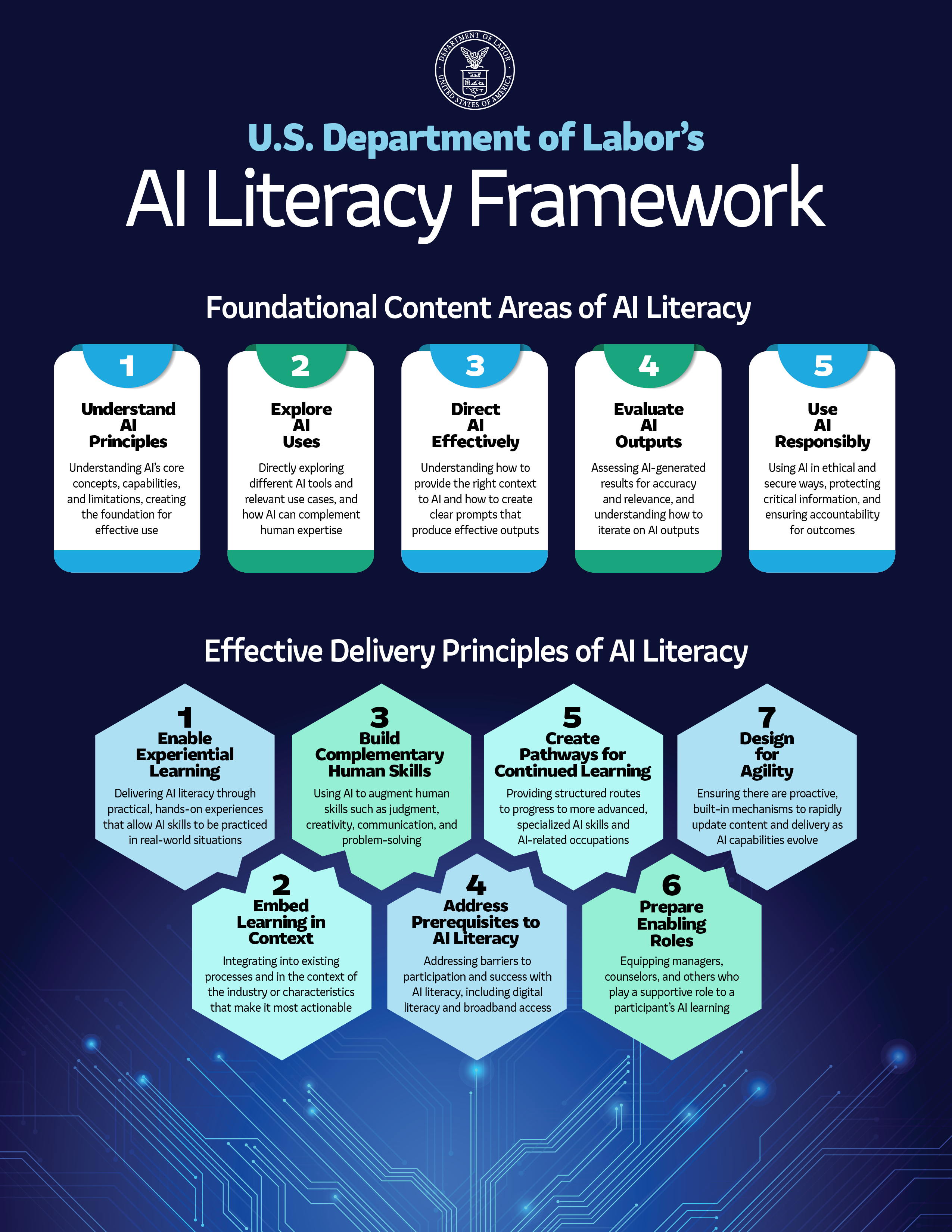
“The U.S. Department of Labor’s Employment and Training Administration today published a framework for Artificial Intelligence literacy, providing a foundation to guide nationwide AI literacy efforts across workforce and education systems.” - DOL
Why HR Should Care (Even If You Are Not “An AI Person”)
This framework sits directly inside HR’s mandate of skills, culture, and risk.
AI literacy becomes a core capability. The DOL positions AI literacy as necessary for workers across sectors, not just in technical roles. That means CHROs and HR leaders will be asked how they are building these competencies into onboarding, learning, and leadership development.
Funding, partnerships, and expectations will align to this model. The framework builds on TEGL 03-25, which encourages use of Workforce Innovation and Opportunity Act funds for AI skills. State workforce boards, community colleges, and apprenticeship programs will design offerings using these five content areas and seven principles. Employers who speak the same language will partner more effectively.
It gives you a national reference standard. Instead of inventing your own AI literacy model from scratch, you now have a government-backed framework that vendors, educators, and regulators will recognize. That is a powerful tool when you evaluate programs or justify investment.
It sits inside a larger national AI strategy. The framework supports America’s Talent Strategy and a federal AI Action Plan that both treat AI literacy as essential to competitiveness and reindustrialization. That context matters when you talk to your C-suite about why this belongs on the 2026 HR agenda, not the 2028 wish list.
The Five Content Areas, Translated For HR Practice
You do not need to adopt every bullet in the framework tomorrow. You do need a clear view of what each content area looks like inside your organization.
1. Understand AI Principles
DOL wants every worker to have a practical mental model of how AI works, including pattern recognition, probabilistic outputs, training versus inference, and the reality of hallucinations.
In practice, this means helping employees understand that AI is a pattern engine, not a decision-maker. They need enough literacy to know that confident output does not equal correct output, that models are trained on historical data, and that human oversight is non-negotiable in high-impact decisions.
2. Explore AI Uses
The framework highlights exposure to real-world use cases across sectors, including productivity support, information assistance, creative help, task automation, and decision support.
For HR, this is your opportunity to showcase practical tools such as drafting job descriptions, summarizing engagement comments, building first-draft learning modules, or organizing schedules. When people see AI solving their actual pain points, resistance drops and curiosity increases.
3. Direct AI Effectively
DOL emphasizes prompting skills like contextual framing, clear instructions, supplying relevant data, and iterating on outputs to improve quality.
Think of this as management training for a digital junior analyst. Not everyone needs to be a prompt engineer, but everyone does need to learn how to set expectations, provide context, and give effective feedback to the system. This is as much communication skill-building as it is technical training.
4. Evaluate AI Outputs
A central theme is critical evaluation, including verifying accuracy, checking completeness, spotting gaps or logical errors, and aligning outputs with strategic intent.
This is where HR’s risk lens becomes essential. Teams must be able to challenge AI-generated content used in hiring, performance, pay, and employee communications. The framework assumes humans remain the final decision makers, and our learning programs need to reinforce that.
5. Use AI Responsibly
Finally, DOL focuses on responsible use, such as protecting sensitive data, following policies, avoiding misuse, managing context-specific risks, and maintaining accountability.
This is the connective tissue between AI literacy and your compliance architecture. Employees need clear guardrails about what they can and cannot put into tools, what must be anonymized, when to involve legal or security, and how accountability works when AI is involved.
The Seven Delivery Principles: How To Build Learning Without Burning Out Your Organization
The delivery principles are a helpful design checklist when you are tempted to simply add another webinar.
Enable experiential learning through hands-on practice using AI tools in live workflows, not passive theory.
Embed learning in context so examples and exercises match your industry, culture, and roles.
Build complementary human skills such as judgment, communication, creativity, and problem-solving alongside AI skills.
Address prerequisites like digital literacy and information literacy before expecting sophisticated AI use.
Create pathways for continued learning with progressive skill-building for frontline employees, power users, and governance leaders.
Prepare enabling roles by equipping managers, coaches, and HR partners to support others’ AI learning and model responsible behaviors.
Design for agility so your AI literacy program can evolve as tools, risks, and regulations change.
This is not about building a massive one-time training program. It is about designing an adaptive learning system that keeps pace with the technology and your business.
A Simple Roadmap For HR: 90 Days To A DOL-Aligned AI Literacy Plan
You do not have to implement the entire framework at once. You do need a plan that moves you from “we should do something about AI” to “here is how we are building AI-ready, responsible teams.”
-
Audit current AI usage. Where are people already using AI in recruiting, learning, HR operations, and line functions?
Identify high-risk, high-impact workflows. Think hiring, performance decisions, pay, safety, and customer impact.
Review the DOL framework with your leadership team. Use the five content areas as a checklist and highlight where your organization is strong or exposed.
-
Choose one of these starting points:
A function under heavy pressure (for example, customer service, operations).
A group most affected by AI disruption (for example, analysts, coordinators, early-career roles).
Then:
Build a foundational session that covers AI principles, use cases, prompting basics, and responsible use, anchored in their real work.
Create two to three simple playbooks: example prompts, do/don’t guidelines, and review checklists aligned to the DOL content areas.
Train managers in that group to reinforce the behaviors and coach to the playbooks.
-
Convert what worked in the pilot into standard learning assets: e-learning, job aids, office hours, and short refreshers.
Embed AI literacy expectations into role profiles, onboarding, and development plans, using the framework to define what “good” looks like at different levels.
Align with IT, legal, and risk to keep your responsible AI policies synchronized with how people are actually working.
How To Position This With Your Executive Team
Your C-suite does not need a technical deep dive. They need a strategic argument about risk, capability, and competitiveness.
Three points to anchor:
This is becoming a national standard. The Department of Labor has now defined what AI literacy means and how high-quality programs should be delivered, as part of a broader federal AI and talent strategy.
You can use this framework as leverage. It provides a ready-made structure you can use to evaluate vendors, design internal programs, and partner with workforce boards and education providers.
Doing nothing increases risk. Without intentional AI literacy and guardrails, employees will keep using tools informally, which creates exposure in data privacy, bias, and decision quality. The framework helps reduce that risk while building a more capable workforce.
Your role as a senior HR leader is not to be the AI expert in the room. Your role is to architect a system where people can use AI confidently, critically, and responsibly, aligned with both your culture and the DOL’s emerging expectations.
